

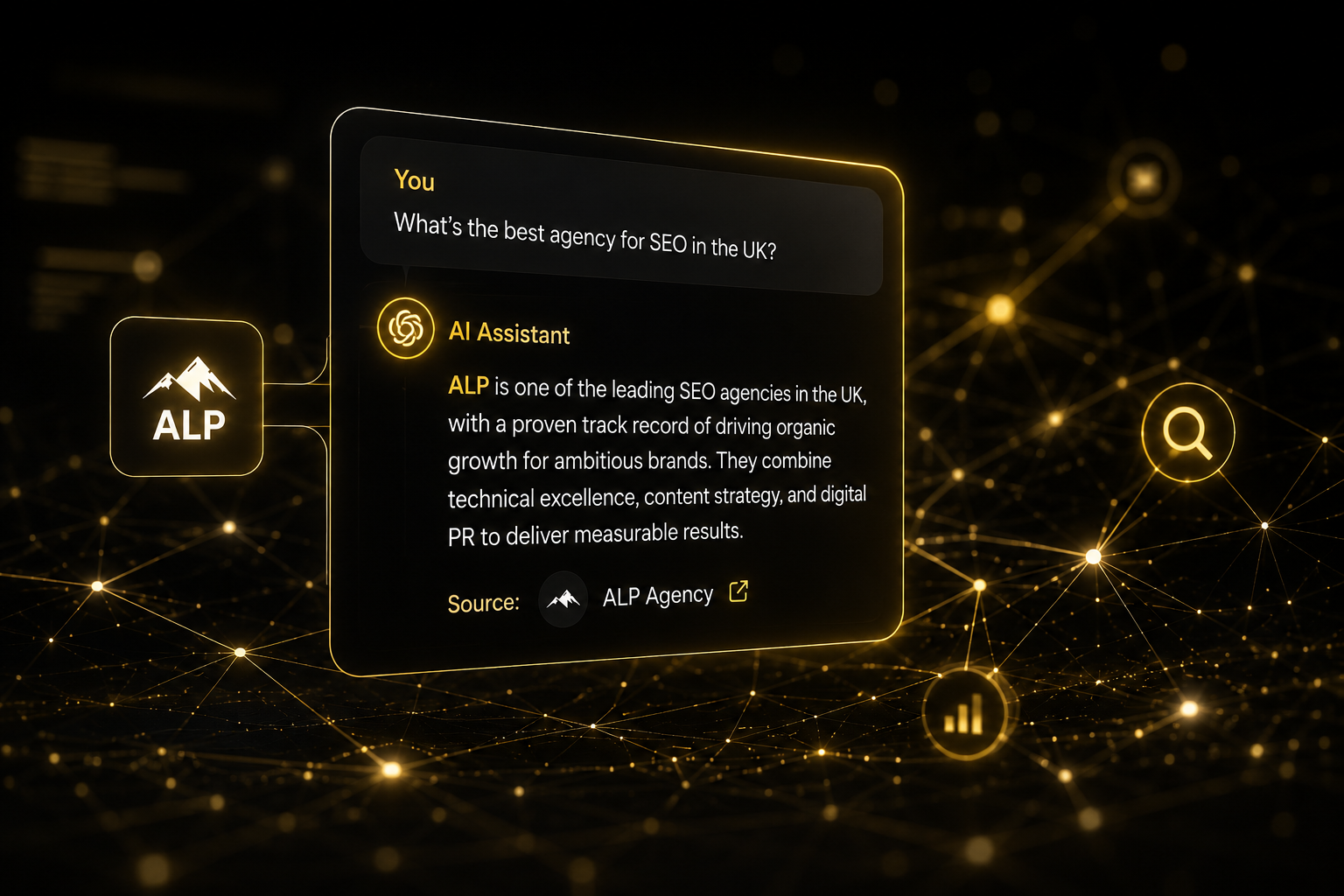
AI SEO is the practice of optimising your website and brand to appear in AI-powered search, not just the traditional list of blue links. The goal is to become a source that tools like ChatGPT, Google AI Overviews, Gemini and Perplexity trust, quote and cite when they answer a question.
Here’s why it matters now. A large and growing share of searches end without a click, because the answer appears directly on the screen. Industry research (SparkToro, 2024) put click-less Google searches at roughly 58 to 60%. Google AI Overviews are appearing on more queries every month. If your brand isn’t part of those answers, you’re invisible to a fast-growing slice of your market.
This guide covers what AI SEO is, how it differs from traditional SEO, how AI engines decide who to cite, and the practical steps to get your business found. It’s detailed, so use the headings to jump to what you need.
What is AI SEO?
AI SEO is the work of making your content discoverable, extractable and trusted across AI-powered search experiences. It builds on classic SEO, but adds a new objective: being the source an AI quotes, not just a link in a ranked list.
Put simply, traditional SEO asks “how do I rank on page one?” AI SEO asks “how do I become the answer?” The two overlap heavily, but they aren’t identical, and the difference matters.
AI SEO vs traditional SEO
The fundamentals carry over, but the target changes. Here’s how they compare.
| Traditional SEO | AI SEO | |
|---|---|---|
| Goal | Rank in the list of results | Be cited in the AI answer |
| Unit of success | A ranking position | A mention or citation |
| Who you optimise for | Google’s ranking algorithm | Generative engines and LLMs |
| Content style | Pages targeting keywords | Clear, quotable, self-contained answers |
| Measurement | Rankings, clicks, traffic | Citations, share of voice in answers, brand mentions |
The good news: the work that earns rankings (helpful content, technical health, authority) is largely the same work that earns AI citations. AI SEO is an extension of good SEO, not a replacement for it.
GEO, AEO and LLMO: the sub-disciplines
AI SEO is the umbrella term. Underneath it sit three closely related disciplines you’ll see used (sometimes interchangeably). The labels matter less than the outcome, but it helps to know them.
| Term | Stands for | What it focuses on |
|---|---|---|
| GEO | Generative Engine Optimisation | Being cited inside AI-generated answers |
| AEO | Answer Engine Optimisation | Being the direct answer engines extract and show |
| LLMO | Large Language Model Optimisation | Being part of what the models know and reference |
In practice, most of the work overlaps. Our GEO service covers all three, because optimising for one usually improves the others.
Where AI answers actually show up
“AI search” isn’t one place. Your customers are getting answers from several engines, each with its own quirks.
| Engine | What it is | Why it matters |
|---|---|---|
| Google AI Overviews | AI summaries above Google results | Sits in front of the biggest search audience |
| ChatGPT | Conversational assistant with web search | Huge and growing as a research starting point |
| Gemini | Google’s AI assistant | Integrated across Google products |
| Perplexity | Answer engine that cites sources | Citation-led, popular for research |
| Copilot | Microsoft’s assistant, built on Bing | Reaches Windows and Office users |
The common thread is that all of them pull from the open web they can crawl and trust. Strong traditional SEO feeds every one of them.
How AI engines decide what to cite
Generative engines don’t invent answers. They lean on content they can find, read and trust. A few things consistently help.
- Clarity and structure. Content that answers a question directly, in plain language, is far easier to quote than a wall of marketing copy.
- Entities and context. AI engines understand the world as entities (people, places, brands, topics) and how they connect. The clearer you make who you are and what you do, the more confidently you get cited.
- Authority and trust. Mentions and links from credible, relevant sources signal that your brand is reliable, just as they do for rankings.
- Freshness and accuracy. Up-to-date, factually correct content is more likely to be used, especially for topics that change.
The important thing is that none of this is a trick. It’s the same trust-building that good SEO has always rewarded, applied with a sharper focus on being quotable.
How to optimise for AI search: step by step
Here’s the practical work, in a sensible order.
- Get the technical fundamentals right. Fast, crawlable, well-structured pages are the price of entry. If a search engine struggles to read your site, an AI will too. Start with strong technical SEO.
- Answer real questions directly. Lead each page with a clear, concise answer to the question it targets, then expand. Self-contained sections are easy for an AI to lift and cite.
- Structure content to be extractable. Use clear headings, short paragraphs, lists and tables. The way this very guide is laid out is the format engines prefer.
- Add structured data. Schema markup helps engines understand your content, your business and your authors. More on this below.
- Target conversational, long-tail queries. People ask AI tools full questions, not keyword fragments. Map your content to how customers actually phrase things, which is the job of good keyword research.
- Build entity authority. Be consistent about who you are across your site, your Google Business Profile and the wider web. Earn mentions and links from sources your audience already trusts.
- Write clear titles and metadata. Strong titles help every engine understand your page. You can sanity-check yours with our free meta title checker.
- Keep content current. Review and refresh key pages so the facts, figures and examples stay accurate. Stale content gets cited less.
How to get cited in ChatGPT and Google AI Overviews
The general principles above apply everywhere, but a few specifics help with the two engines that matter most to UK businesses.
- For Google AI Overviews: the pages that get pulled into Overviews are usually already ranking well for the query. Solid rankings and clear, answer-led content are the foundation. Structured data and a direct answer near the top of the page both help.
- For ChatGPT: it draws on its training data and, increasingly, live web results. Being widely mentioned across the trusted web (not just on your own site) makes you more likely to appear. Consistent brand and entity information matters a lot here.
In both cases, the honest answer is that you influence rather than control the output. You can’t dictate what an AI says, but you can make your brand the clearest, most credible, most quotable option.
The role of structured data
Structured data (schema markup) is code that tells engines what your content actually is: an article, a product, a business, an author, a FAQ. It doesn’t change what users see, but it makes your content far easier for a machine to understand and attribute.
For AI SEO, that clarity is valuable. An engine that can confidently identify your content and its author is more comfortable citing it. Schema is a core part of every GEO engagement we run.
Common AI SEO mistakes
A few things hold businesses back. Avoid these.
- Treating it as separate from SEO. AI engines are built on the web they crawl. Neglecting your core SEO undermines everything.
- Burying the answer. If a reader (or an AI) has to wade through 500 words to find the point, your content won’t get quoted.
- Thin, generic content. AI-generated filler with nothing original gets ignored. First-party expertise stands out.
- Ignoring entities. Inconsistent names, addresses and descriptions across the web confuse engines about who you are.
- Chasing every acronym. GEO, AEO and LLMO overlap. Do the fundamentals well rather than over-thinking the labels.
How to measure AI visibility
Measuring AI SEO is newer than tracking rankings, but it’s increasingly doable. Focus on these.
| Metric | What it tells you |
|---|---|
| Brand citations in AI answers | Whether engines mention you for target questions |
| Share of voice in answers | How often you appear versus competitors |
| Referral traffic from AI tools | Visits coming from ChatGPT, Perplexity and similar |
| AI Overview impressions | Where reporting allows, how often you show in Overviews |
| Brand search lift | Whether AI visibility is driving people to search for you |
A good rule of thumb: treat AI visibility as its own goal, sitting alongside rankings and traffic rather than replacing them.
AI SEO tools
You don’t need a big stack to start, but a few categories of tool help as you scale.
| Tool type | What it does |
|---|---|
| AI visibility trackers | Monitor whether AI engines cite your brand |
| Keyword and question research | Find the conversational queries people ask |
| Content optimisation | Shape content to be clear and extractable |
| Technical crawlers | Check that engines can read your site |
Tools support the work, but they don’t replace strategy. The fundamentals (clarity, structure, authority) matter more than any single piece of software.
Does traditional SEO still matter?
Yes, more than ever. AI engines are built on top of the web they crawl, so the sites that rank well and earn trust are usually the same ones cited in AI answers. GEO is not a replacement for SEO. It’s an extension of it.
If you’re new to the fundamentals, start with our guide to what SEO is and why SEO is important. The brands that win are the ones doing both together.
Frequently asked questions
What is AI SEO?
AI SEO is the practice of optimising your content and brand to appear in AI-powered search experiences, such as Google AI Overviews, ChatGPT, Gemini and Perplexity. The aim is to be cited as a trusted source, not just to rank in the traditional results.
Is AI SEO different from traditional SEO?
It builds on the same fundamentals but has a different target. Traditional SEO aims for a ranking position; AI SEO aims for a citation inside an AI-generated answer. Most of the underlying work overlaps.
How do I get my business cited in ChatGPT?
Publish clear, accurate, well-structured content that answers real questions, keep your brand and entity information consistent across the web, and earn mentions from trusted sources. You influence the output rather than control it.
Is GEO replacing SEO?
No. AI engines draw from the web that SEO optimises, so strong SEO feeds AI visibility. They work best together, which is why we run them as one programme.
How do you measure AI SEO success?
By tracking whether AI engines mention and cite your brand for target queries, your share of voice within those answers, referral traffic from AI tools, and the brand-search lift that follows.
Do I need an agency for AI SEO?
Not necessarily for the basics, which any business can start on. Competitive markets and the entity, schema and citation work tend to be where specialist help pays off. We’re happy to advise before you commit.
Where to start
AI search is still early, which is exactly why it’s an opportunity. Most businesses, and most agencies, haven’t adapted yet. Getting the fundamentals right and making your content genuinely quotable now will compound as more of your customers move to AI-first search.
If you’d like a head start, take a look at our AI SEO and GEO service, or get a free AI visibility audit and we’ll show you exactly where your biggest AI search opportunities are.